

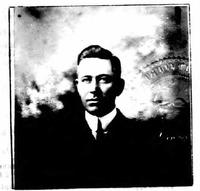
The 1888 Okemos Union School class roster included the name of 6 year old Hugh Earle McGiveron. Hugh was the son of William Harold (1842-1914) and Martha Loretta (Eggleston) (1854-1947) McGiveron. The elder Mr. McGiveron, born and raised in Okemos, was in his later years, the proprietor of a Haslett summer hotel.
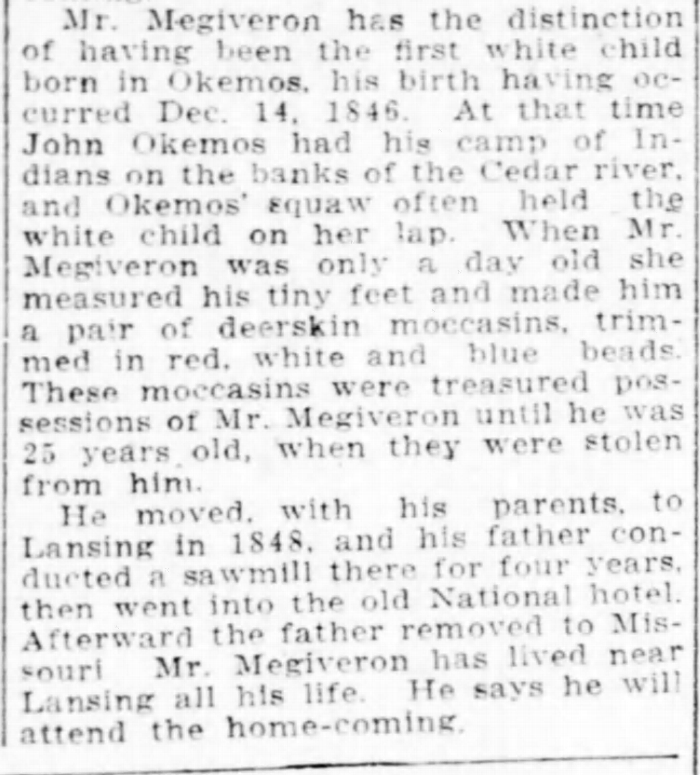
McGiveron, William H, father of Hugh Earle, Lansing State Journal, 27 Aug 1913, Page 2
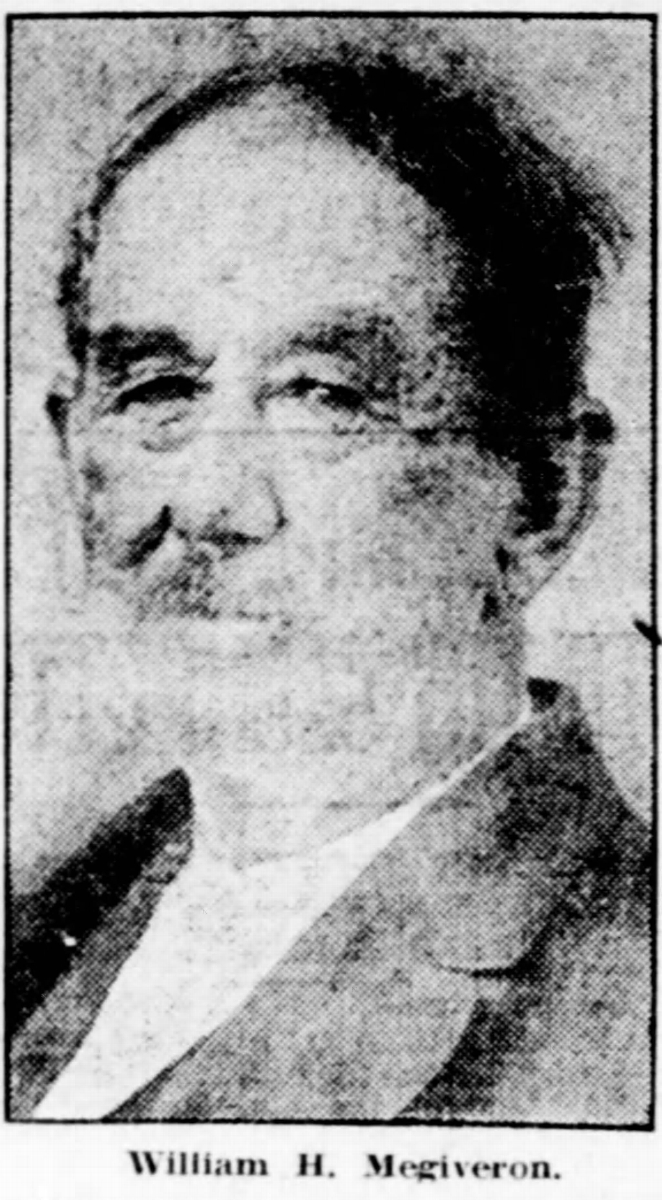
McGiveron, William H, father of Hugh Earle, Lansing State Journal, 27 Aug 1913, Page 2
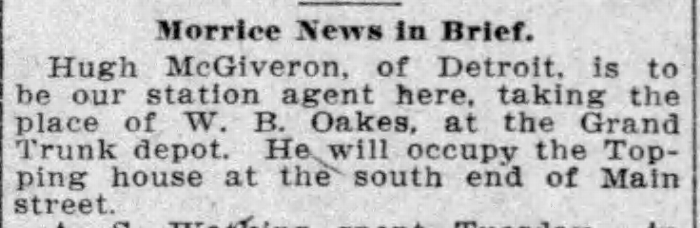
Hugh and his older sister, attending school together, grew up in the Okemos area. On 10 August 1898 Hugh was wed to Mary Pearlette “Pearl” Strickland in Haslett by a justice of the peace. About the same time as the marriage, Hugh went to work for the Grand Trunk Railroad. According to the 1900 US Federal Census, Hugh was the telegraph operator at Meridian, Ingham County moving, according to the 1910 US Federal Census, to work out of Perry, Shiawassee County.
The World War I Draft Registration form described Hugh as of medium height, medium build with dark brown hair and blue eyes. Although not involved in military activities Hugh applied for and received a passport, dated 8 October 1918, to go, under the auspices of the Army YMCA, for “war work” overseas in England, France and Italy. The passport revealed his residence that year was Grand Haven, Ottawa County, and he was a railroad agent “being sent for duty with the AEF in connection with YMCA.” Hugh was listed as 5' 91/2” in height with a fair complexion.
McGiveron, Hugh, Grand Trunk RR agent, The Flint Journal, 14 April 1910, Page 16
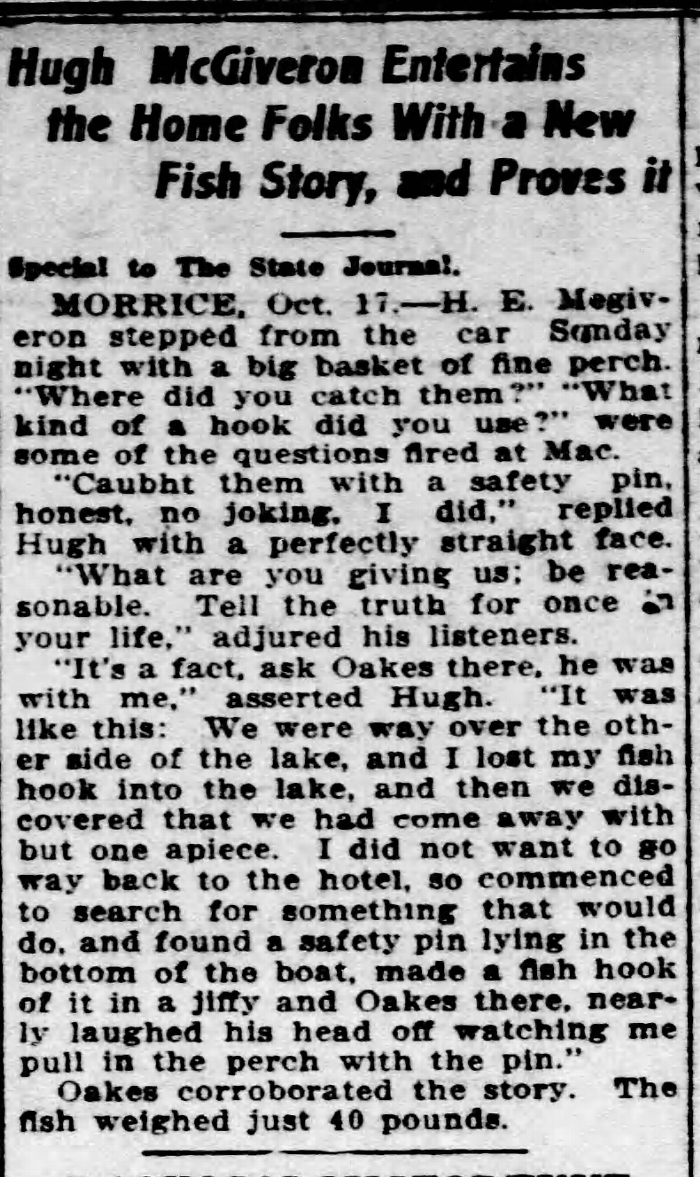
McGiveron, Hugh, fishing story, Lansing State Journal, 17 October 1911
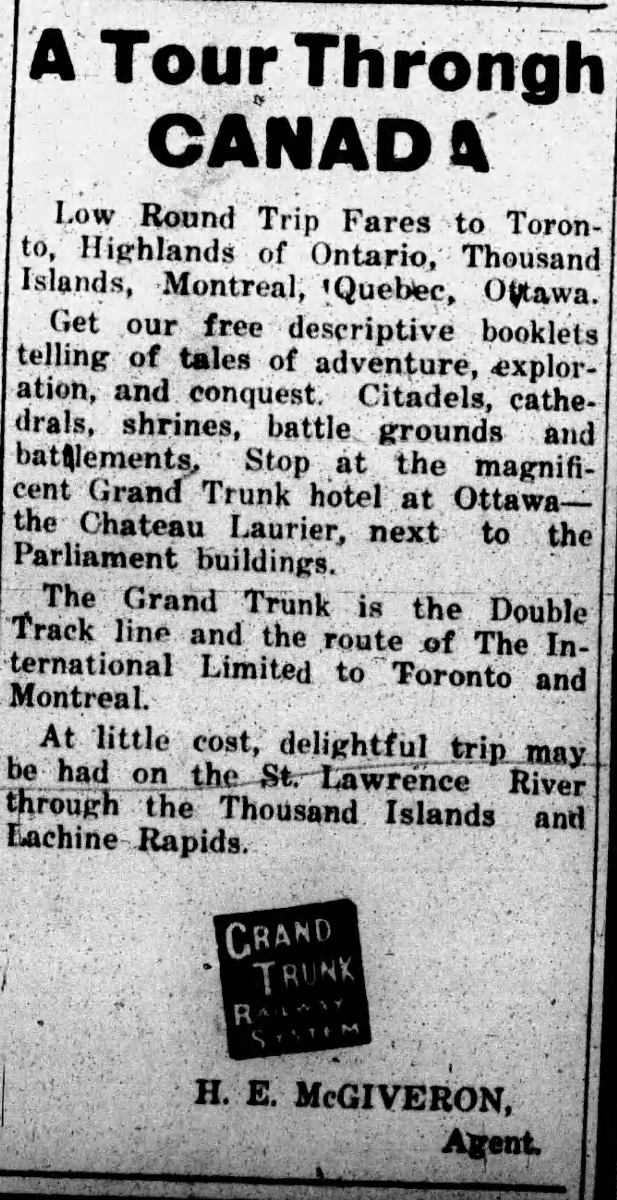
McGiveron, Hugh, Grand Trunk RR agent, Grand Haven Tribune (Grand Haven, MI), 30 July 1917
It was in either 1919 or 1920, after 19 years with the Grand Trunk, that Hugh was hired as “traffic manager” at Motor Wheel in Lansing. Motor Wheel “company was established in 1920 through the merger of several local firms, including the W.K. Prudden Wheel Company, Gier Pressed Steel Company, Auto Wheel Company, and Weis & Lesh Manufacturing” (Google search). Hugh was hired in at the ground floor because “by 1924, it became the world's top manufacturer of wood and steel automotive wheels, and by 1934, it controlled roughly one-third of the entire United States wheel market .” (Google search)
His daily role in the logistics of the company was coordinating railroad and trucking networks, negotiating rates, schedules, contracts, making sure supplies reached assembly lines by a deadline, and coordinating with state and federal agencies especially during the war time era.
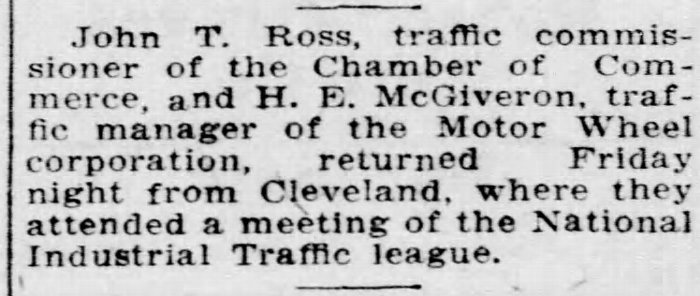
McGiveron, Hugh, Traffic Manager Motor Wheel Corp., Lansing State Journal, 28 May 1921, Page 19
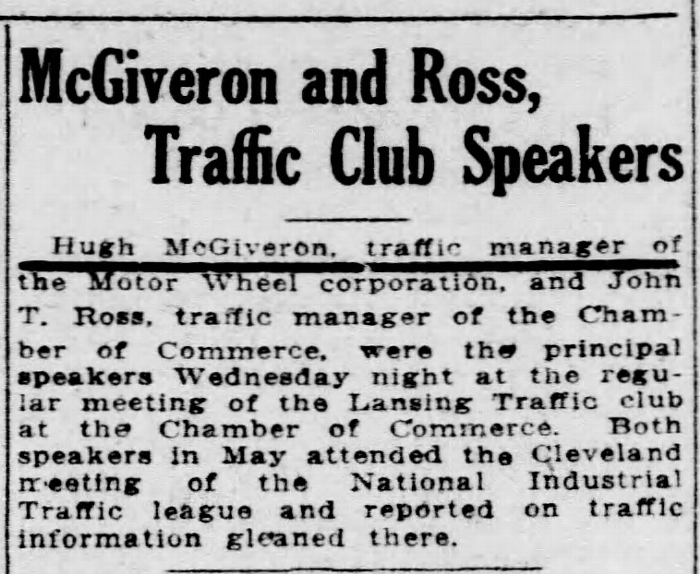
McGiveron, Hugh, Speaker Lansing Traffic Club, Lansing State Journal, 9 June 1921, Page 13
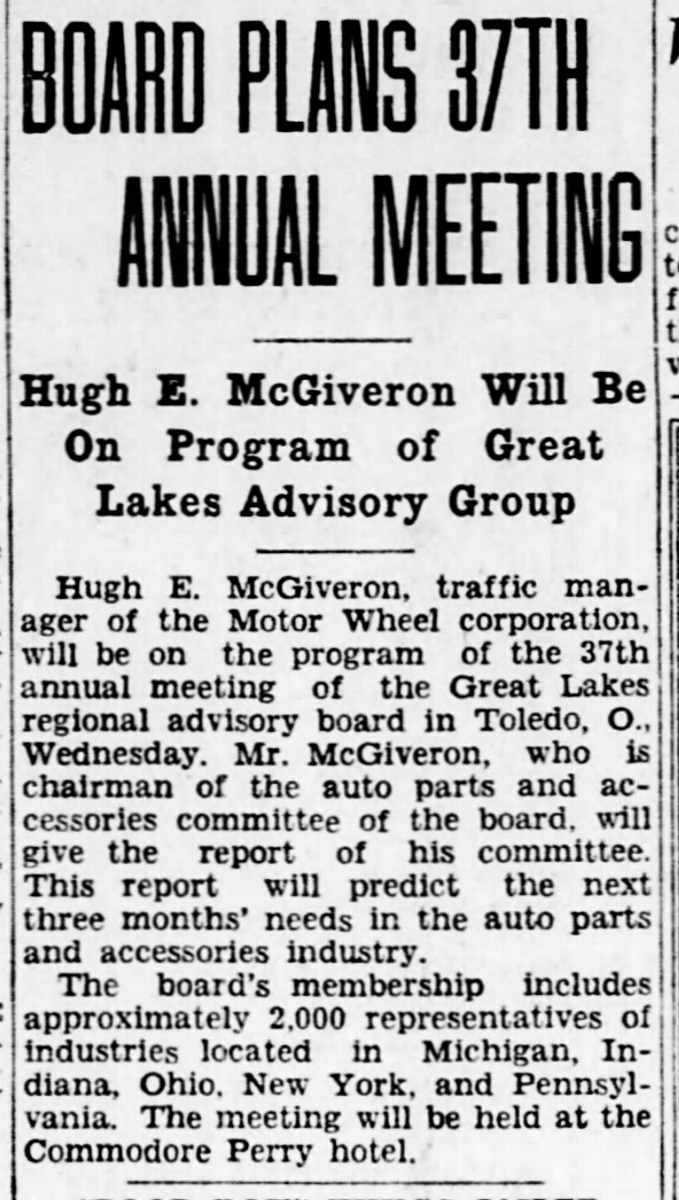
McGiveron, Hugh, Speaker Great Lakes Regional Advisory Board, Lansing State Journal, 27 March 1934, Page 13
The December 15, 1944 issue of "Motor Wheel News" listed exactly what the factory was massively producing during the crucial World War II years.
"Supply truck wheels, combat wheels for "ducks," combat wheels for tank destroyers, combat spiders, Centrifugal brake drums for fighters, three-inch high explosive projectiles, 40mm gun casings, 75mm armor piercing shot, implement discs, driver discs for M18 Hellcat tank destroyers, idler wheels for M4 Sherman tanks, road wheels for Hellcats, amphibian wheels for "alligators."
Bogie wheels and hubs for M4 Sherman tanks, propeller domes for fighters and bombers, fuse seat liners, rockets and motors, 40mm armor piercing cartridge cases, three-inch anti-aircraft projectiles, three-inch 50 cal. H.V. projectiles, three-inch semi-armor piercing projectiles, dolly wheels for trailers, torpedo fuel tanks, hemisphere bomb noses, 57mm T4 containers, cylinder head covers, body rim guards for aerial bombs, sleeve bearing retainers for "ducks."
Aeroplane brackets, Centrifugal brake drums for Superfortresses and Flying Fortresses, spacers for amphibian "ducks," brake drums for trucks, spider plates for machine gun mounts, hubs for 155mm gun mounts, hubs and drums for 105mm gun mounts, tractor wheels."
On 9 March 1942 the US Navy awarded Motor Wheel the Navy E. Award because the manufacturer had produced 1 million brass 40x311 mm shell casings. In the next 3 years Motor Wheel received a total of 5 E Army-Navy Awards for outstanding productions of needed military supplies. Behind all of this was a logistics man named Hugh McGiveron whose hand was guiding the supplies to where they needed to be.
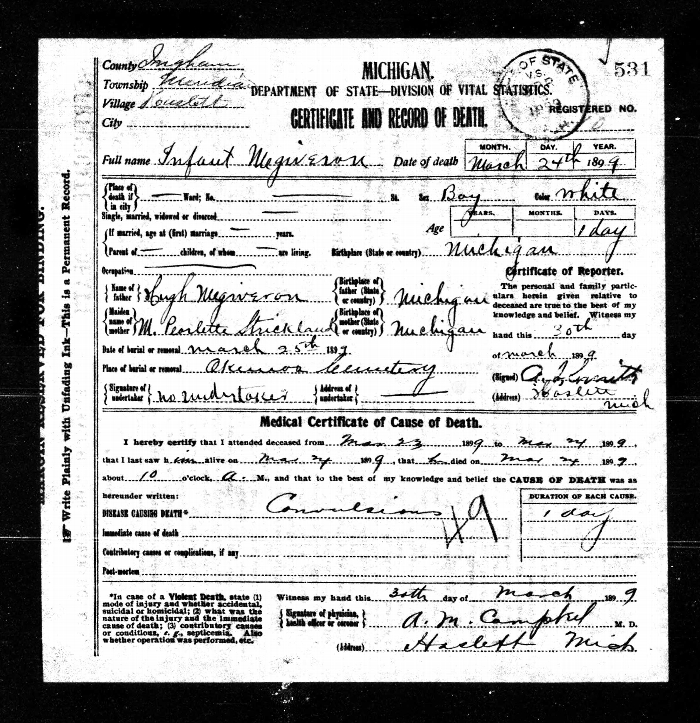
At home Pearl was raising their children. Hugh and Pearl lost their first born child, a son one day old, 24 March 1899. Five more children were born to their union, 4 girls and another son named after his father. The family owned a home and lived in the Pine Lake (now Lake Lansing) area, Meridian Township from the 1920's on. This was the same community in which Hugh's father had a summer hotel resort for many years.
Infant son of Hugh and Pearl (Strickland) McGiveron, 1899 Michigan Certificate of Death
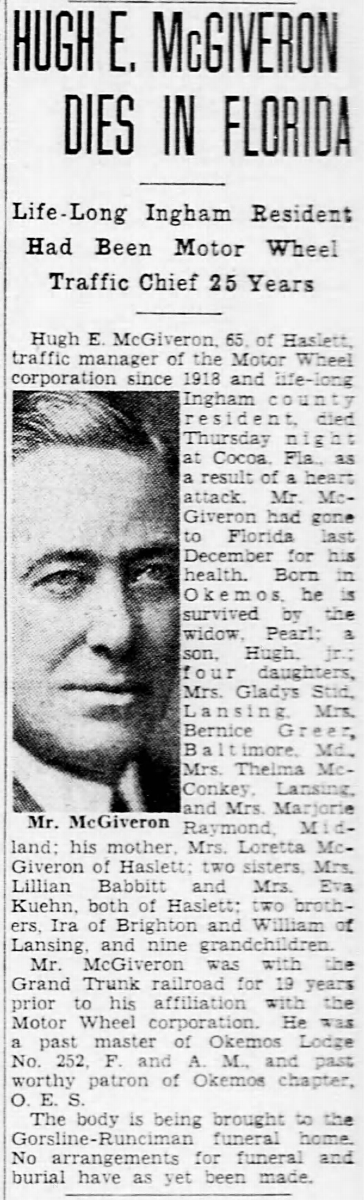
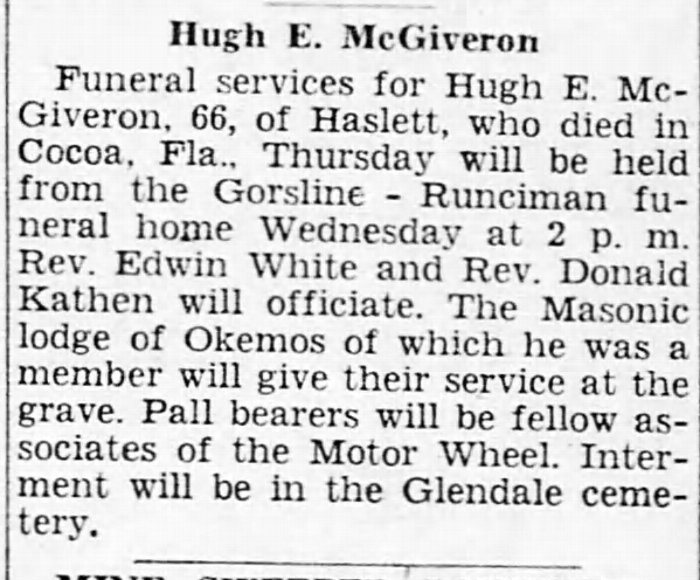
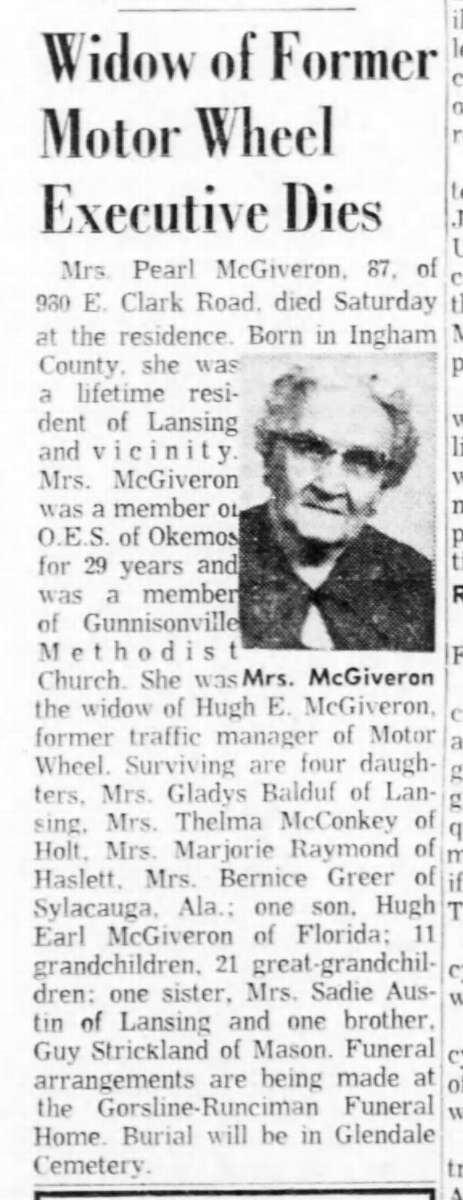
Hugh enjoyed fishing and his fishing tales were well known. By the mid-1940's he began experiencing health issues and he and Pearl went to Florida for a much needed rest. It was there at Cocoa, Brevard County that Hugh passed away from a heart attack, 28 February 1943. His body was shipped back to Lansing and he was interred Glendale Cemetery. Pearl, born 12 January 1876, Ingham County, lived until 13 April 1963, Lansing. She was interred next to her husband at Glendale.
McGiveron, Hugh, obit, Lansing State Journal, 26 Feb 1943, Page 1
McGiveron, Hugh Earle (married Mary Pearl Strickland 1898) obit Lansing State Journal, Sunday, February 28, 1943
McGiveron, Mary Pearlette (Strickland) wife of Hugh McGiveron, obit, Lansing State Journal, 14 April 1963, Page 3
As the Motor Wheel “traffic manager”, Hugh made his mark as a prominent executive in mid-20th century industrial logistics. He helped build a manufacturer that was a heavy contributor to stemming the tide of war in Europe and fragmenting an empire in Asia. His leadership abilities were essential in helping the US win a world war.